

You’ve seen a message like “imao” pop up in a chat and wondered what it means. Maybe you thought it was a typo. Maybe you thought it was just another “lol.” It is not that simple. IMAO Meaning in Text is a short slang that people use all the time online. It shows up in comments, DMs, and group chats. Many people use it without thinking. Today, we will clear up the confusion.
Slang changes fast. New words appear every week. Some stay and some fade away. IMAO Meaning in Text is one that has stayed around. It is short, easy, and quick to type. That is why people love it. You will see it on almost every social app.
Knowing IMAO Meaning in Text helps you chat with confidence. You will not feel lost in a conversation anymore. You will know when to use it and when to skip it. You will also understand the tone behind it. This guide keeps things simple and clear. Let’s break it down step by step.
What Does IMAO Mean in Text?
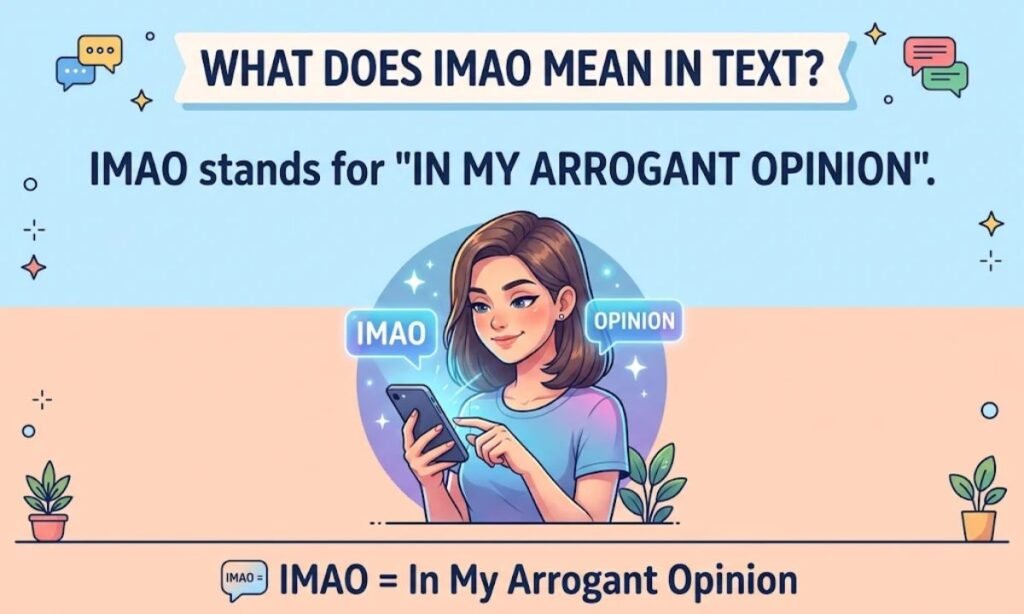
IMAO meaning in text comes down to one phrase: In My Arrogant Opinion. The writer says something bold, then admits it might sound a little full of itself. That self-aware wink is the whole point.
Think of it like a friend saying, “Okay, I know I’m being dramatic, but this is the best pizza in town.” The tone is light. Nobody’s actually being arrogant.
You’ll see it in group chats, social media comments, online forums, and private chats. It works best when the topic is low stakes, like music, food, movies, or fashion.
Here’s a quick snapshot of the IMAO definition:
- Full form: In My Arrogant Opinion
- Type: Internet initialism and informal digital communication slang
- Purpose: Sharing a bold personal opinion with humor
- Tone: Playful, ironic, confident, or sarcastic
- Closest relatives: IMO, IMHO, IMNSHO
Examples:
- “That album is a masterpiece, IMAO.”
- “IMAO, the sequel ruined the whole story.”
- “Cold pizza beats hot pizza, IMAO.”
So when someone asks what does IMAO means, the short answer is a humorous opinion with a confident edge.
Is IMAO a Typo for LMAO?
Sometimes, yes. This is the biggest source of confusion around IMAO meaning in text. In a sans-serif font, “I” and “l” are nearly twins, so people misread or mistype them all the time.
Fast typing makes it worse. Autocorrect, small phone keyboards, and late-night texting create plenty of spelling confusion. One slip and “LMAO” becomes “IMAO.”
The difference matters, because the two terms mean very different things. One shares an opinion. The other reacts to something funny.
- IMAO: In My Arrogant Opinion
- LMAO: Laughing My Ass Off
- Clue for IMAO: It follows or introduces an opinion
- Clue for LMAO: It follows a joke, meme, or funny video
Compare these two messages:
- “That restaurant is overrated, IMAO.” (opinion, so it’s the real IMAO)
- “He walked straight into the glass door, imao.” (laughter, so it’s probably a typo)
The IMAO vs LMAO question usually answers itself once you read the full sentence. When you can’t tell, just ask. “Wait, did you mean LMAO?” takes five seconds and clears everything up.
Is IMAO an Acronym or Slang Term?

It’s both, with one small technical note. IMAO is an initialism, because you read each letter on its own: I-M-A-O. An acronym is technically a set of initials you pronounce as a word, like NASA.
In everyday talk, though, people call all of these “acronyms.” So if you search for the IMAO acronym, you’ll find it described that way. Nobody will fault you for using the looser term.
It’s also internet slang, since it lives mostly in casual conversations and text messaging. You won’t find it in a textbook or a legal contract.
- I = In
- M = My
- A = Arrogant
- O = Opinion
Dictionaries that track texting abbreviations treat IMAO as a playful riff on IMHO. It belongs in the same family as other popular texting slang that borrows a familiar pattern and twists one word.
IMAO Meaning in Text From a Guy

When a guy sends IMAO, he’s usually staking a claim in a friendly debate. Think sports, games, music, cars, or food. The tone is competitive but joking.
For example, a guy might text, “Best player of all time, IMAO.” He knows people will argue. The sarcastic expression invites the argument instead of shutting it down.
In a dating chat, it can also be a playful confidence move. It signals “I’m sure of myself, but I’m not taking this too seriously.”
- Common topics: Sports, gaming, movies, cars, music
- Usual tone: Banter and friendly rivalry
- In dating chats: Light teasing or a confident flex
- Watch out for: Sounding dismissive if the topic is personal
Example chat:
A: Who’s the best cook in the group?
B: Me, IMAO.
A: Prove it. Dinner at yours.
Don’t read too much into it. If a guy uses IMAO, he’s most likely just being funny and a little cocky on purpose.
IMAO Meaning in Text From a Girl

When a girl sends IMAO, the meaning stays the same: In My Arrogant Opinion. What changes is often the flavor. It tends to show up in fashion talk, relationship advice, pop culture, and group decisions.
A girl might write, “The second outfit wins, IMAO.” She’s confident, a bit funny, and she’s inviting you to disagree. It can also work as self-deprecating humor, as in “I’m the best parallel parker here, IMAO,” after a messy attempt.
Context matters even more in flirty chats. “You looked best at the party, IMAO” reads as a compliment with a wink.
- Common topics: Outfits, shows, celebrities, plans, relationship takes
- Usual tone: Playful, teasing, or flirty
- In group chats: A light way to push a decision
- Watch out for: Mixing it up with LMAO in rushed replies
Gender doesn’t change the IMAO slang meaning. Tone, topic, and your history with the person do all the heavy lifting.
IMAO Meaning in Gen Z
Gen Z uses IMAO the way it uses most slang: loosely, fast, and with a sense of humor. It’s less about formal meaning and more about the vibe. A short lowercase “imao” at the end of a comment feels natural and relaxed.
Younger users also lean on ironic expressions. Saying “my opinion is objectively correct, imao” pokes fun at how seriously people take online arguments. The joke is that nobody’s opinion is truly objective.
It also pairs well with other social media slang like “ngl,” “fr,” and “lowkey.” Stacked together, they create a casual, chatty voice.
- Style: Lowercase, quick, often without punctuation
- Humor type: Irony and exaggerated confidence
- Where it lives: Comments, group chats, DMs, social media comments
- Pairs with: ngl, fr, lowkey, tbh
Example: “that trend was never funny imao.” It reads as a mock-serious verdict, which is exactly the Gen Z sweet spot.
What Tone Does IMAO Have?

IMAO sounds humorous, ironic, confident, or sarcastic. The writer is often poking fun at how strongly they feel. That’s why it’s such a flexible little phrase.
The exact tone depends on four things: the topic, the people involved, the words around it, and your past chats. A joke between best friends can land badly with a coworker. Reading the room matters in online communication.
Let’s break down the four main tones.
Playful Confidence
This is the most common use. The writer is sure of their take but isn’t picking a fight. They want a smile, not a showdown.
“My playlist is better than yours, IMAO.” Everyone knows it’s a friendly flex.
- Signal: Light topic, friendly group
- Effect: Sparks banter
- Best reply: A joking counterclaim
Sarcasm
Here, IMAO sharpens the sarcasm. The writer says one thing and means the opposite. The sarcastic tone is obvious when the situation contradicts the words.
“Wow, that was the most organized event ever, IMAO.” If the event was chaos, you know exactly what they mean.
- Signal: Praise that doesn’t match reality
- Effect: Adds bite to a sarcastic comment
- Risk: Can sound mean if the reader misses the joke
Self-Aware Arrogance
The writer knows the statement sounds cocky and says so. That honesty is what makes it funny. It’s classic self-aware arrogance.
“I could have designed that logo better, IMAO.” They’re laughing at themselves while still making a point.
- Signal: Self-teasing
- Effect: Disarms criticism
- Best reply: “Okay, show us then.”
Serious Confidence
Sometimes IMAO introduces a genuine, strong view. “IMAO, the company needs a new strategy.” The humor is thin, and the confident opinion is real.
This is the riskiest use. The word “arrogant” can make the writer sound dismissive, even if they didn’t mean it that way.
- Signal: Work or serious topics
- Effect: May feel blunt or condescending
- Better choice: IMO or “in my view”
What Does IMAO Mean on Social Media?
Across platforms, the IMAO meaning stays steady: In My Arrogant Opinion. What changes is the format. A TikTok comment is short and punchy. A WhatsApp message might be part of a longer debate.
The sentence and the topic decide whether it’s an intentional opinion or a typing mistake. If the post is a funny clip, “imao” probably means LMAO. If it’s a hot take, it’s the real thing.
Here’s a quick platform overview:
- TikTok: Comment sections and opinion videos
- Snapchat: Quick private chats and snaps
- Instagram: Reel comments, captions, and direct messages
- WhatsApp: Group chats and decision threads
- SMS: Everyday one-on-one texting
Let’s walk through each one.
What Does IMAO Mean on TikTok?
On TikTok, IMAO pops up under videos about music, fashion, relationships, and “unpopular opinion” trends. The comment section is basically a giant debate club. IMAO lets people jump in with an attitude.
For example: “The second outfit wins, IMAO.” Or: “This trend was never funny, IMAO.” Both are bold takes wrapped in humor.
Watch for ambiguity, though. “That’s the funniest video today, imao” probably means LMAO.
- Typical spot: Comments and replies
- Common topics: Trends, outfits, performances, hot takes
- Typo risk: High on laughing reactions
This is where the IMAO meaning on TikTok gets tricky. Read the video first, then the comment.
What Does IMAO Mean on Snapchat?
Snapchat chats move fast. People type quickly, send snaps, and move on. IMAO shows up as a playful opinion between friends.
“You should wear the blue one, IMAO.” “That party was boring, IMAO.” Both sound like casual banter between people who know each other well.
Because messages disappear and get typed in a hurry, spelling confusion is common here. Check the whole message before deciding.
- Typical spot: Private chats and replies to snaps
- Tone: Teasing and quick
- Typo risk: Medium to high
The IMAO meaning on Snapchat is usually friendly. Strangers rarely use it.
What Does IMAO Mean on Instagram?
On Instagram, IMAO can land in Reel comments, story replies, captions, and DMs. It softens a strong take by making the confidence feel exaggerated on purpose.
“Best picture in the carousel, IMAO.” “This is their best Reel yet, IMAO.” Both read as friendly and opinionated.
In Instagram captions, creators sometimes use it to add attitude to a post. A caption like “Monday outfit, my favorite so far, IMAO” feels relaxed and funny.
- Typical spot: Comments, captions, story replies, DMs
- Tone: Friendly confidence
- Best use: Light opinions about photos, style, and content
That covers IMAO meaning on Instagram in a nutshell.
What Does IMAO Mean on WhatsApp?
WhatsApp is full of decisions. Where to eat, which date to pick, what gift to buy. IMAO fits right in when someone wants to nudge the group with a joke.
“We should choose the earlier time, IMAO.” “IMAO, option three makes the most sense.” Both push a preference without sounding too bossy.
Some members might read it as LMAO, especially in a busy chat. When clarity matters, a plain “IMO” saves time.
- Typical spot: Group chats and planning threads
- Tone: Gentle push with humor
- Tip: Use IMO when stakes are higher
You’ll see IMAO meaning on WhatsApp pop up most in friend and family groups.
What Does IMAO Mean in SMS?
In a regular text message, IMAO in text messages introduces a bold or funny opinion. It’s one-on-one, so the tone is easier to read. You usually know the person.
A: Which movie should we watch?
B: The original is the only good choice, IMAO.
B strongly prefers the original and jokes about their own confidence. A can laugh, argue, or agree.
- Typical spot: Two-person texts
- Tone: Personal and teasing
- Typo risk: Low, since the context is clearer
IMAO Examples in Different Tones
Examples help more than definitions, so here’s a bigger set. The words around IMAO decide whether a message feels funny, sarcastic, friendly, flirty, or annoyed. Use these as IMAO sentence examples and IMAO conversation examples you can borrow.
Each group below shows a different mood. Notice how the surrounding words set the tone, not IMAO alone.
Funny Examples
Funny IMAO examples lean on obvious exaggeration. The joke is that the speaker is clearly overselling themselves.
- A: Who’s the best cook here? B: Me, obviously, IMAO.
- A: Who should control the playlist? B: I should, IMAO. The rest of you need help.
- A: Was your joke funny? B: Funniest of the year, IMAO.
- “I’m the only person who can parallel park, IMAO.”
Sarcastic Examples
Sarcastic IMAO examples say the opposite of what’s true. The gap between the words and the situation creates the humor.
- A: He arrived an hour late and blamed traffic. B: Very responsible of him, IMAO.
- A: They added another meeting to reduce meetings. B: Brilliant strategy, IMAO.
- A: She ignored every message but says communication matters. B: Excellent skills, IMAO.
- “Great idea to skip the instructions, IMAO.”
Friendly Examples
Friendly IMAO messages share a warm preference. Nobody’s trying to win. They just want to chat.
- A: Which photo should I post? B: The third one looks best, IMAO.
- A: Pizza or burgers? B: Pizza is always the answer, IMAO.
- A: Like the new song? B: Best track they’ve released, IMAO.
- “That café has the best fries in town, IMAO.”
Flirty Examples
Flirty IMAO replies use the cocky tone to deliver a compliment. The playful frame makes it feel safe and charming.
- A: Who looked best at the party? B: You, IMAO. It wasn’t close.
- A: Should I change my profile picture? B: Nope, you look too good in that one, IMAO.
- A: Am I distracting you? B: You’re my favorite distraction, IMAO.
- “Best smile in the room, IMAO.”
Annoyed Examples
Annoyed IMAO responses use the phrase to push back. Here the tone turns sharper, and the word “arrogant” starts to sting.
- A: Why did you reject the plan? B: It made no sense, IMAO.
- A: Did I handle it badly? B: You could’ve listened first, IMAO.
- A: Should we give him another chance? B: He’s had enough, IMAO.
- “Maybe read the message before replying, IMAO.”
In serious disagreements, IMAO can sound dismissive. The writer seems to say their view beats yours.
Where Does IMAO Appear in a Sentence?
IMAO is flexible. It sits at the start, at the end, or sometimes alone. Each spot changes the feel slightly. Placement is part of how IMAO meaning in text shifts from bold to casual.
Think of it like seasoning. Early on, it announces the flavor. At the end, it’s a garnish.
- Start: Announces a strong view
- End: Adds a humorous disclaimer
- Alone: Rarely works without context
At the Beginning
When IMAO opens the sentence, it warns the reader that a bold take is coming. “IMAO, the first design is much cleaner.” It feels deliberate and a little theatrical.
This works well in debates and group votes. It sets up the opinion, then lets it land.
- Effect: Builds anticipation
- Best for: Debates and group choices
- Example: “IMAO, we should leave early.”
At the End
In the end, IMAO works like an afterthought. “The first design is much cleaner, IMAO.” It sounds relaxed and more joking.
This is the most common placement. It lets the opinion speak first, then adds a wink.
- Effect: Light and humorous
- Best for: Casual chat
- Example: “That show is overrated, IMAO.”
As a Standalone Reply
IMAO rarely works alone. It labels an opinion, so it needs the opinion attached. A bare “IMAO” leaves the reader confused.
A: Which option do you prefer?
B: IMAO.
That reply says nothing. A better version is “Option two, IMAO.” If someone sends it alone, they may have meant LMAO.
- Problem: No actual opinion shared
- Possible cause: A typo for LMAO
- Fix: Add the opinion or ask what they meant
How to Reply When Someone Says IMAO
Respond to the opinion, not just the letters. Match the energy of the chat. If they’re joking, joke back. If they’re serious, answer seriously.
A good reply keeps the conversation moving. It also shows you read the message properly. That’s the heart of how to reply to IMAO.
Here are options for every mood.
Neutral Replies
Use these when you want to stay calm and keep things easy.
- “That’s fair.”
- “I see your point.”
- “I disagree, but I get why.”
- “That’s one way to look at it.”
- “What makes you think that?”
Funny Replies
Match the humor and tease them gently.
- “At least you admit the arrogance.”
- “Your confidence has been officially noted.”
- “A humble opinion was never on the menu.”
- “Thanks for the expert ruling.”
- “Bold of you to say that out loud.”
Flirty Replies
Keep it light and a little cheeky.
- “Confident and opinionated. I noticed.”
- “You might be right this time.”
- “I’ll allow it because it’s you.”
- “Bold claim. Convince me.”
- “That arrogant opinion is oddly attractive.”
Serious Replies
Use these when the topic matters or the tone felt sharp.
- “I respect that, but I see it differently.”
- “Can you explain your reasoning?”
- “That sounded a bit dismissive.”
- “Let’s consider the other side too.”
- “I agree with the point, not the delivery.”
If you can’t tell whether they meant IMAO or LMAO, ask: “Did you mean IMAO or LMAO?” It’s quick and avoids awkward guesses.
Also read meanings on IMAO Meaning in Text: Discover What This Popular Slang Really Means in 2026
Is IMAO Rude or Offensive?
IMAO isn’t a swear word, so it’s not offensive by itself. The trouble is the word “arrogant.” If the humor isn’t clear, the phrase can come across as snobby.
Rudeness depends on the person, the topic, and the mood. Between close friends, it’s harmless. With a stranger in a heated thread, it might sting.
It’s usually fine when:
- Friends are joking around
- The topic is light, like food or music
- The writer is clearly teasing themselves
- The chat already feels playful
It may sound disrespectful when:
- The topic is serious or sensitive
- The writer dismisses someone’s experience
- It follows an insult
- It appears during an argument
- The reader doesn’t get the joke
Compare these two:
- “Chocolate is the best flavor, IMAO.” (playful)
- “Your feelings make no sense, IMAO.” (dismissive and hurtful)
When in doubt, choose a kinder phrase. A smile emoji can also help signal that you’re joking.
Can You Use IMAO at School or Work?
Keep IMAO for informal messaging. It belongs in friend chats, social media comments, and casual online forums. It doesn’t fit professional settings.
The word “arrogant” can create the wrong impression, even as a joke. A manager or teacher may not share your sense of humor. Once it’s sent, you can’t take it back.
Avoid it in:
- Academic assignments
- Messages to teachers
- Professional emails
- Client communication
- Business reports
- Job applications
- Formal complaints
Clearer alternatives for work:
- “In my opinion”
- “From my perspective”
- “My recommendation is”
- “I believe”
- “Based on the available information”
Even IMO and IMHO can feel informal in strict workplaces. When in doubt, write the full phrase.
IMAO vs. IMO, IMHO, and LMAO
These terms look alike, but they do different jobs. Mixing them up can change your message completely. This quick comparison clears it up.
IMAO vs IMO, IMAO vs IMHO, and IMAO vs LMAO are the three searches people make most often.
| Term | Meaning | Main purpose | Typical tone |
| IMAO | In My Arrogant Opinion | Sharing a bold opinion humorously | Confident or sarcastic |
| IMO | In My Opinion | Sharing a personal view | Neutral |
| IMHO | In My Humble Opinion | Softening a personal view | Polite or modest |
| IMNSHO | In My Not-So-Humble Opinion | Sharing a strong view humorously | Confident |
| LMAO | Laughing My Ass Off | Reacting to something funny | Amused |
| LOL | Laugh Out Loud | Showing light amusement | Casual |
IMAO sits closest to IMO and IMHO because all three introduce an opinion. It sounds a lot like LMAO but carries a totally different meaning. IMNSHO is its nearest cousin in tone, since both admit the opinion isn’t modest.
A simple rule helps: opinions use IMO, IMHO, IMNSHO, and IMAO. Laughter uses LMAO and LOL. If you can sort a message into one of those two buckets, you’ve got it.
Where Did IMAO Come From?
IMAO began as a humorous spin on IMHO. IMHO means “in my humble opinion.” IMAO swaps “humble” for “arrogant,” which creates a funny contrast.
Instead of politely shrinking their opinion, the writer inflates it on purpose. That exaggeration is the joke. It mirrors how older internet communities liked to riff on existing abbreviations.
IMAO existed long before TikTok or Snapchat. Early online forums and chat rooms were already playing with variations like IMNSHO. Social media simply gave the phrase more places to travel.
- Roots: Older internet culture and forum slang
- Parent term: IMHO
- Cousin term: IMNSHO
- Today: Spread through comments, DMs, and group chats
Dictionaries that cover internet slang terms describe IMAO as an initialism built on IMHO. They also note its common use with irony and self-deprecating humor.
Common Mistakes People Make With IMAO
Even simple slang causes slip-ups. These are the mistakes I see most, and each one is easy to fix. Avoiding them keeps your messages clear and friendly.
- Using it for laughter: If something is funny, type LMAO, not IMAO.
- Using it in serious talk: The word “arrogant” can sound harsh.
- Sending it alone: A bare IMAO leaves the other person guessing.
- Overusing it: Every message with IMAO gets tiring fast.
- Using it with strangers: The joke needs shared context.
A quick check before you hit send helps. Ask yourself, “Would my friend get the joke?” If the answer is no, pick a plainer phrase.
Read the message out loud in your head. If it sounds smug instead of silly, rewrite it. Small edits protect your tone in digital communication.
Quick Tips to Use IMAO the Right Way
Using IMAO well takes a little practice. These tips keep your messages natural and fun. They also help you avoid being misread.
- Know your audience: Use it with friends who share your humor.
- Pick light topics: Food, movies, music, and style work best.
- Keep it short: One opinion, one IMAO.
- Add context: A joke or emoji makes the tone clear.
- Check for typos: Make sure you didn’t mean LMAO.
- Switch for serious talk: Use IMO or “I think” instead.
Try it in your next group chat. Share a harmless hot take, like your favorite snack, and watch the replies roll in. It’s a good way to see how people read the tone.
Conclusion
IMAO meaning in text is simple once you know it. It stands for “in my arrogant opinion.” People use it to share a bold view with a smile. It is a playful twist on IMO and IMHO. Now you can read it without any confusion. You will spot it in chats, comments, and posts. It always adds a cheeky and confident tone. Knowing IMAO meaning in text keeps you ahead of every trend.
Using IMAO meaning in text the right way is easy. Use it with friends when you want to joke around. Keep it away from formal emails and serious talks. Let your tone show that you are only teasing. A smiley or emoji can make it feel even lighter. Slang like this keeps online chats fun and fresh. So go ahead and drop IMAO in your next message.
FAQs
What does “lmao” mean in texting?
“LMAO” stands for “laughing my ass off.” It’s a text slang term used to show that something is very funny.
What does IMAO stand for?
IMAO stands for “in my arrogant opinion.” It’s a playful, slightly cheeky twist on IMHO, used to share a bold opinion.
What does IMAO stand for in Gen Z slang?
In Gen Z slang, IMAO means “in my arrogant opinion,” used to state a view with confidence and a bit of humor. Some people also use it as a typo or variation of “LMAO.”
What does IMO mean in Gen Z?
IMO means “in my opinion.” Gen Z uses it to share a personal view in a casual, non-pushy way.
What Does IMAO Mean in Text?
IMAO means “In My Arrogant Opinion.” People use it to share a strong view in a playful, confident way.
What Does IMAO Stand For?
IMAO stands for “In My Arrogant Opinion.” It is a cheeky twist on IMHO, which means “In My Humble Opinion.”
Is IMAO the Same as LMAO?
No, they are different. IMAO is about giving your opinion, while LMAO means “Laughing My Ass Off” and shows you find something funny.
How Do You Use IMAO in a Text?
Put IMAO before or after your opinion, like “IMAO, pizza beats burgers.” Use it with friends when you want to sound bold or joking.
1 thought on “IMAO Meaning in Text: Discover the Real Meaning Behind This Popular Slang in 2026”