
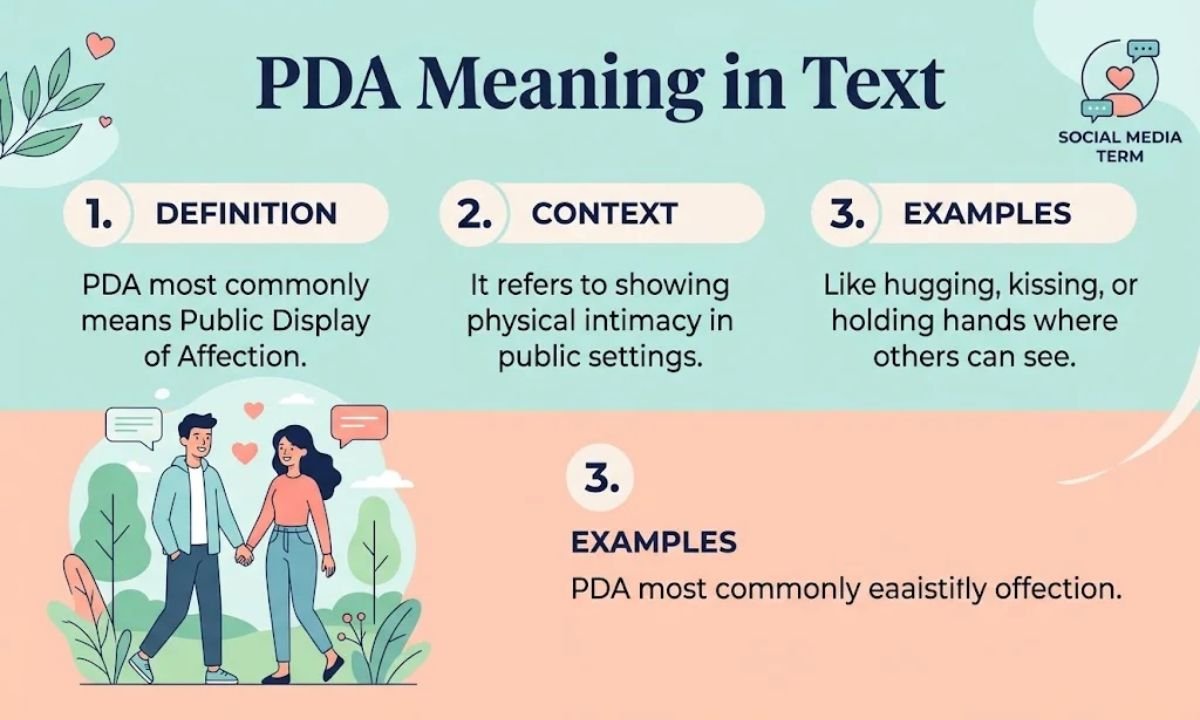
You have probably seen “PDA” pop up in a chat and wondered what it means. The PDA meaning in text is not what most people expect. It is one of those slang terms that changes with the person using it. Some people use it as a joke, and some use it seriously. A single wrong guess can make a conversation awkward. Let’s clear up the confusion right now.
Most people use PDA to mean “public display of affection.” Think of hugging, kissing, or holding hands in front of others. The PDA meaning in text often shows up when friends tease a couple. It can also be used to say someone is being too cute in public. The tone is usually playful and light. Context is the key to getting it right.
In 2026, slang moves faster than ever, and PDA is no exception. The PDA meaning in text can now change based on the app or the group. On social media, it may be used for fun captions and memes. In private chats, it can be a sweet or shy way to talk about feelings. Knowing the right meaning helps you reply with confidence. Keep reading to learn every use of this popular term.
PDA Meaning in Text
Let’s start with the basics. PDA meaning in text always points back to affection shown openly. Someone is hugging, kissing, or sharing romantic feelings where others can see.
Think of it as a label people stick on couple behavior. It’s not an insult or a compliment on its own. The tone around it decides how it lands.
Here’s an example. You’re at a mall food court and see two people sharing fries while one rests a head on the other’s shoulder. Later you text a friend, “Saw so much PDA at the food court today.” Your friend instantly gets the picture.
- Meaning: showing love or closeness in front of others
- Core ideas: public affection, visibility, and audience
- Typical users: teens, young adults, couples, and social media users
- Example: “Their PDA is next level.”
PDA Meaning in Relationship
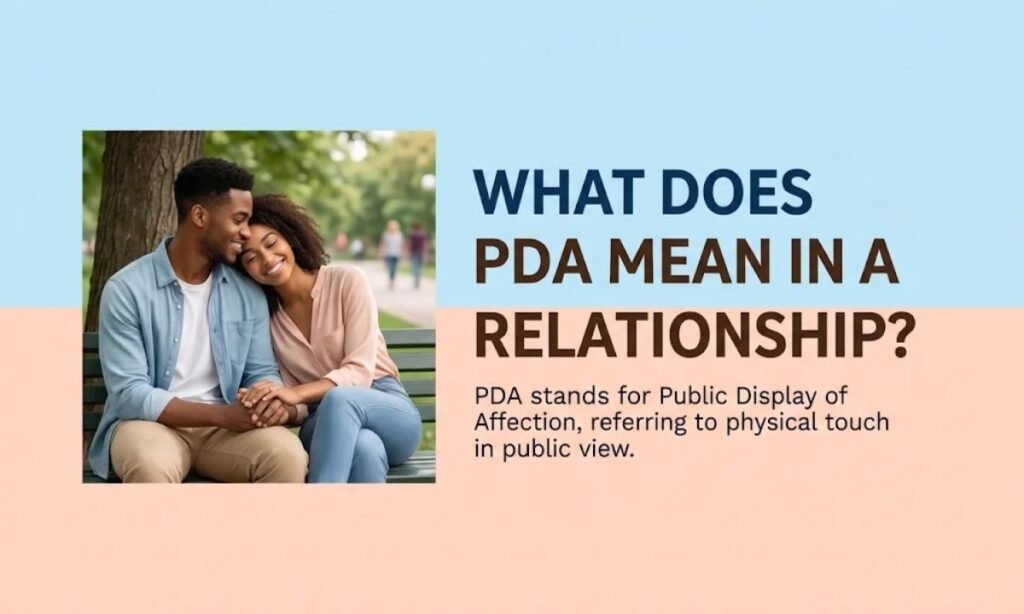
In a relationship, PDA in relationships describes how comfortable partners feel showing love around others. Some couples hold hands everywhere. Others save every hug for home.
Neither style is wrong. It’s about personal preferences and comfort. Problems start when one partner wants more than the other can give.
Picture Sara and Ali. She loves posting couple pics and kissing hello at the station. He’s shy and prefers a quick wave. They talked it out and settled on holding hands in public with the big stuff kept private. That’s PDA meaning in text turning into a real conversation about personal boundaries.
- Healthy sign: both partners feel respected
- Red flag: pressure to perform affection for others
- Tip: talk about comfort levels early
- Example text: “I’m cool with hand holding, just not kissing in front of my parents.”
What Does PDA Mean in School
At school, PDA usually shows up in rulebooks, not just chats. Many schools limit showing affection publicly to keep the school environment comfortable for everyone.
Students also use it in group chats. A friend might text, “Teachers are watching, no PDA by the lockers.” The PDA meaning in text here is a playful warning. [Keep it light and everyone gets it.]
Think of one real scenario. Two classmates hug a little too long between periods. A friend jokes, “Bro, PDA alert.” The couple laughs and steps apart. Nobody got in trouble.
- Common school rule: hand holding is fine, kissing isn’t
- Where it’s enforced: hallways, cafeterias, buses, and events
- Why: respect, safety, and a focused learning space
- Chat example: “Dance night rule: zero PDA.”
PDA Meaning in Corporate
In corporate settings, PDA is almost never casual slang. It refers to affection between colleagues at work, which most workplace policies discourage.
HR teams care about professionalism and comfort. Even a harmless hug between coworkers who are dating can make others uneasy. That’s why many handbooks mention it in their conduct sections.
For example, a manager might remind a team before an office party, “Keep it professional, and that includes PDA.” PDA meaning in text at work is therefore more of a polite caution than a joke.
- Typical policy: keep romantic gestures out of the office
- Allowed: warm greetings, handshakes, and friendly tone
- Risk: it may affect team trust or break conduct rules
- Tip: read your company handbook if unsure
PDA Meaning in Email
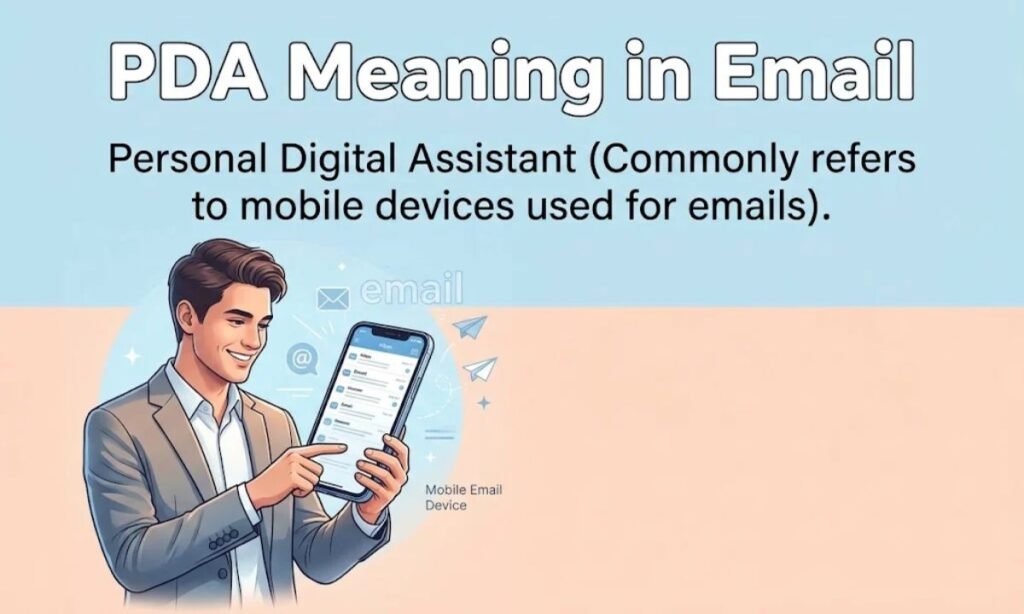
Emails are formal by nature, so PDA rarely appears. When it does, it usually sits inside a HR notice, a school letter, or an event guideline about public behavior.
You may spot it in a wedding invite or a venue rules email, for example. A line like “Please keep PDA minimal during the ceremony” is polite and clear. In this setting PDA meaning in text stays serious and professional.
Don’t toss it into work emails casually. Spelling out “public displays of affection” the first time avoids confusion, especially for readers from other cultural norms.
- Where you’ll see it: policy emails, venue rules, and school notices
- Best practice: write the full phrase first, then use the acronym
- Avoid: jokes about PDA in professional emails
- Example: “Our resort asks guests to limit public displays of affection (PDA) near the pool.”
PDA Slang Meaning Explained
As slang, PDA is a quick way to label romantic gestures people can see. It works as a casual comment, a gentle tease, or a mild complaint.
The PDA slang meaning has a social flavor. It’s less about the act and more about the observer’s reaction. “Ew, PDA” and “Aww, PDA” mean completely different things.
Say you’re at a concert and a couple starts slow dancing near you. You nudge a friend and whisper, “PDA at a rock show, really?” That’s PDA meaning in text moving into everyday speech.
- Positive: “Cute PDA, I’m happy for them.”
- Negative: “Get a room, too much PDA.”
- Playful: “Our PDA game is strong tonight.”
- Key idea: context sets the tone
What Does PDA Mean in Chat?
In chat, PDA appears when people discuss couples, gossip about friends, or joke about affectionate behavior. The PDA meaning in chat is the same as everywhere else, but the vibe is looser.
Chats move fast, so people keep it short. You’ll see “PDA much?” or “no PDA pls” tossed in without explanation. Readers fill in the rest from the situation.
Here’s a typical scene. A friend sends a photo of a couple cuddling at a bus stop with the caption “PDA level 100.” You reply with a laughing emoji and move on. PDA meaning in text is understood in a second.
- Used for: reactions, jokes, and gossip
- Length: usually one to three words
- Common pairings: “too much,” “zero,” “level 100”
- Example: “They’re giving PDA all day.”
PDA Meaning on Snapchat
On Snapchat, PDA often appears in captions on Snapchat stories or private snaps. People use it when sharing couple photos or poking fun at friends who are being cute together.
Because snaps disappear, users feel freer to joke. A caption like “PDA break at the arcade” feels casual and fleeting. That relaxed style shapes how PDA meaning in text works on this app.
Imagine a friend sends a snap of two buddies sharing a milkshake with two straws. The caption says “PDA alert.” You know it’s all in fun.
- Where: stories, chats, and Snap Map captions
- Mood: playful and temporary
- Example: “Too much PDA on my story today”
- Tip: ask before posting someone else’s moment
PDA Meaning on TikTok
On TikTok, PDA shows up in TikTok videos, captions, and comments. Creators post “couple goals” clips, and viewers react with comments about how much PDA they see.
The topic also drives debate. Some people love it, others find it awkward. That makes PDA meaning in text a regular guest in relationship content and duet threads.
A real-world style example: a creator films a “day with my boyfriend” clip with hugs and forehead kisses. The top comment reads, “The PDA is so wholesome.” Another says, “Bro, keep some for later.” Both are valid takes.
- Where: video captions, comments, and hashtags
- Content types: couple vlogs, prank clips, and etiquette debates
- Common comment: “PDA queen/king”
- Note: trends change fast, so check recent posts
PDA Meaning on Instagram
On Instagram, PDA appears in social media captions, reels, and Instagram comments. A couple photo with a long caption often attracts “love the PDA” in the replies.
Instagram is also where online affection gets polished. People post anniversary tributes, birthday notes, and shared moments. In that world, PDA meaning in text includes sweet captions, not only hugs.
For instance, someone posts a beach picture with “Best day with you.” A friend comments “Okay, PDA noted, you two are adorable.” It’s friendly, light, and shows approval.
- Where: posts, stories, reels, and DMs
- Style: often cheerful and supportive
- Example: “Love the PDA vibes”
- Watch out: private moments can feel overshared
PDA Meaning on WhatsApp
On WhatsApp, PDA turns up in WhatsApp conversations with friends and family. Group chats love to tease couples, so the phrase flies around fast.
Because many people use WhatsApp across ages, the meaning sometimes needs explaining. A cousin might ask, “What’s PDA?” You answer, “Public Display of Affection.” Easy. That’s PDA meaning in text in action.
Say a wedding group chat lights up with photos. Someone writes, “Groom and bride doing PDA already.” Everyone laughs and sends cake emojis.
- Where: group chats, family threads, and status replies
- Audience: mixed ages and backgrounds
- Example: “They always do PDA in front of everyone.”
- Tip: add a short explanation for older relatives
PDA Meaning in SMS
In plain SMS, PDA works the same way but feels more direct. Character limits and quick replies keep messages short and punchy.
You might text, “No PDA tonight, my dad’s coming.” Short, clear, and funny. PDA meaning in text messages stays consistent across apps and carriers.
SMS also reaches people who aren’t on social platforms. That makes it a good place to spell things out the first time. After that, the acronym is fair game.
- Style: brief and to the point
- Example: “Some people don’t like PDA.”
- Best use: quick plans, jokes, and reminders
- Bonus: works on any phone, no app needed
PDA as an Acronym
As an acronym, PDA stands for Public Display of Affection. Each letter has a clear job: P for public, D for display, A for affection. The PDA acronym meaning is easy to remember because it describes the action.
Acronyms like this travel well because they save time. One short word replaces a long phrase. That’s why PDA meaning in text spread so easily through texting abbreviations.
Compare it with “LOL” or “BRB.” Those started as shortcuts and became part of everyday talk. PDA followed a similar path, though it’s older than most chat slang.
- P: Public
- D: Display
- A: Affection
- Similar acronyms: FYI, OMG, BTW, IDK
PDA as Internet Slang
As internet slang, PDA is used in commentary about dating, friendship, and social behavior. It lives in memes, captions, and reaction posts.
People rarely define it anymore because most users already know it. When PDA meaning in text shows up with no context, readers often guess correctly from the scene around it.
A quick scenario: a viral clip shows a couple hugging at an airport. The comments fill with “airport PDA hits are different.” Nobody asks what PDA means. It’s become a shared language.
- Spread through: memes, trends, and short videos
- Used for: humor, approval, and light criticism
- Reader skill: guessing meaning from context
- Related slang: “couple goals,” “get a room”
Types of PDA
Not all PDA looks the same. The types of PDA fall into three main groups: physical, emotional, and online. Knowing the difference helps you read a message correctly.
Many people only think of kisses and hugs. But a loving comment on a photo counts too. This wider view makes PDA meaning in text far more useful for everyday talk.
Here’s a quick comparison to keep handy:
- Physical PDA: hugging, kissing, and holding hands
- Emotional PDA: compliments, loving words, and care
- Online PDA: captions, tags, and couple posts
- Mixed PDA: a hug while posting a story at the same time
PDA in Physical Context
Physical PDA is the easiest to spot. It includes hugs, kisses, cuddling, and walking arm in arm in public places like parks, malls, and restaurants.
Different settings change how it feels. A hug at an airport is welcome. A long kiss in a quiet library is less so. Understanding PDA meaning in text helps you describe these moments fairly.
For example, two people greet each other at a train station with a big hug. Bystanders smile. A similar hug in a crowded elevator might get awkward looks. Same act, different space.
- Light: holding hands, quick hugs, forehead kisses
- Moderate: longer hugs, cuddling on benches
- Heavy: extended kissing in crowded areas
- Rule of thumb: match the mood of the room
PDA in Emotional Context
Emotional PDA is about words and expressions of emotional affection. Compliments, supportive messages, and kind public shoutouts all count.
It’s softer than physical PDA but can still draw comments. Someone writing “You’re my best friend and my favorite person” under a post is showing PDA. That small shift expands PDA meaning in text beyond touch.
Imagine a girlfriend tagging her partner with “So proud of you today.” Friends respond with hearts. No hugging involved, but the public affection is clear.
- Examples: public compliments, thank you notes, and encouraging messages
- Benefit: feels warm without being physical
- Risk: overly intense posts may feel awkward to others
- Tip: keep it genuine, not performative
PDA in Online Context
Online PDA means expressing love through social media platforms, comments, tags, and shared content. It’s the digital version of holding hands in public.
Because audiences are huge, online PDA gets reactions fast. A single anniversary post can gather hundreds of likes. That reach is why PDA meaning in text matters so much on apps.
Think of an Instagram story with a couple photos and a sweet note. Friends reply with hearts, and a few tease “Okay, PDA warning.” It’s affection for the audience, just like in real life.
- Forms: posts, stories, reels, and couple photos
- Audience: followers, friends, and sometimes strangers
- Pros: celebrates love, builds connection
- Cons: privacy concerns and pressure to post
PDA in Funny Tone
In a funny tone, PDA turns into a joke. People exaggerate to tease couples or friends who are being extra cute.
The humor works because everyone knows the subject. When PDA meaning in text is clear, jokes like “Their PDA needs a seatbelt” make sense right away. Funny replies keep things light.
Try this: two friends hold hands during a movie, and someone whispers, “Call the PDA police.” Everyone chuckles. No harm done.
- Joke styles: exaggeration, puns, and playful warnings
- Example: “They can’t stop PDA even in class”
- Best used: among friends who know each other well
- Avoid: jokes that embarrass people deeply
PDA in Serious Tone
In a serious tone, PDA appears in conversations about rules, comfort, or inappropriate behavior. People talk about boundaries, respect, and social etiquette.
For instance, a parent might text, “Please keep PDA low around the grandparents.” That’s not a joke. It’s a request grounded in personal comfort. PDA meaning in text here reflects respect, not humor.
These serious responses work best when calm and clear. Accusing language can make things tense, while honest, kind words usually help.
- Context: rules, family events, and shared spaces
- Example: “Some people are uncomfortable with PDA in public.”
- Goal: respectful understanding
- Tip: use “I” statements, not blame
PDA in Romantic Tone
In a romantic tone, PDA is positive and sweet. Couples may say they enjoy it or joke that they can’t hide their feelings.
Here PDA meaning in text signals comfort and joy with the relationship. A couple might say, “We don’t mind PDA when we’re together.” That sentence carries warmth and confidence.
Picture a couple on anniversary night, hands intertwined across the table. One texts a friend, “Yeah, we’re doing PDA tonight, no regrets.” The tone is happy and unbothered.
- Feelings: closeness, pride, and affection
- Examples: “Love the PDA vibes” and “Our PDA is on point”
- Best for: couples and close friends
- Remember: both partners should feel good about it
PDA in Social Discussions
People discuss PDA in articles, podcasts, and comment threads. They debate how much is too much and where lines should be drawn.
These relationship discussions reveal a lot about how society thinks. Some voices call PDA sweet and human. Others call it unnecessary. PDA meaning in text is the starting point for most of those debates.
For example, a podcast host may ask, “Is PDA okay in restaurants?” Callers share views from all over. The answers show how social expectations differ from home to home.
- Debate topics: age limits, places, and intensity
- Common view: keep it respectful
- Example: “PDA is common in some cultures but not in others.”
- Takeaway: opinions vary, and that’s okay
PDA in Cultural Context
Culture shapes how people view PDA. In some countries, a hug or kiss in public is normal. In others, even holding hands may raise eyebrows.
That’s why cultural differences matter. A traveler can accidentally offend locals without meaning to. Knowing PDA meaning in text isn’t enough, so you should also learn local cultural norms.
For example, a couple visiting a conservative area might choose to skip kissing outdoors. They aren’t hiding love. They’re showing respect for local customs.
- More open cultures: hugging and kissing are common
- More reserved cultures: modest behavior is expected
- Travel tip: observe locals before acting
- Rule: respect beats comfort when visiting new places
PDA in Real Chat Example
Examples make everything clearer. Here’s a short exchange that shows how people use PDA naturally.
A: Did you see Maya and Dan at the café?
B: Yes, so much PDA.
A: Aww, they’re adorable.
B: True, but they were sharing one chair.
A: Okay, that’s a lot of PDA.
Notice how the word shifts tone from teasing to approval. This is PDA meaning in text at its most natural. No definition needed, because the context does the work.
- Notice: short sentences and reactions
- Notice: emojis often replace extra explanation
- Pattern: setup, reaction, joke
- Tip: copy the tone your friends use
PDA Grammar and Language Role
Grammatically, PDA works as a noun. It names a behavior rather than describing a single action. You say “They show PDA,” not “They PDA.”
Some people stretch it into a verb, like “PDAing in public.” That’s casual and not standard. In careful writing, PDA meaning in text should stay a noun.
Here’s a simple comparison. “Their PDA surprised me” is correct. “They PDA a lot” sounds odd to most readers.
- Part of speech: noun
- Plural: “PDAs” is possible but rare
- Verb use: informal and not recommended
- Example: “That’s too much PDA for me.”
Sentence Usage of PDA
PDA can sit in many places in a sentence. It can be a subject, an object, or an adjective-like phrase.
Here’s how that looks. “PDA makes me cringe” uses it as a subject. “I don’t mind PDA” uses it as an object. Understanding PDA meaning in text helps you place it smoothly in each case.
Different PDA sentence usage examples show the flexibility. It fits statements, questions, and quick reactions alike.
- Subject: “PDA is common at concerts.”
- Object: “They avoid PDA at work.”
- Modifier: “That’s a PDA moment.”
- Question: “Is PDA allowed here?”
Formal vs Informal Usage
PDA fits informal language best. Friends, family, and followers use it freely. In formal writing, it’s rare and usually spelled out.
Formal documents like handbooks might write “public displays of affection (PDA)” once, then shorten it. PDA meaning in text for casual chats needs no such ceremony.
If you aren’t sure, ask yourself who’s reading. A friend gets “no PDA, lol.” A principal or HR manager gets the full phrase.
- Informal: chats, captions, and jokes
- Formal: policies, notices, and letters
- Bridge: define it once, then abbreviate
- Example: “Please limit public displays of affection (PDA) on campus.”
How to Reply When Someone Mentions PDA
Your reply depends on the tone. Funny, serious, neutral, or flirty all work if they match the moment. Matching energy keeps the chat natural.
The good news is you have plenty of options. PDA meaning in text doesn’t demand a special script. Just read the room, then choose a response that fits.
For example, a friend texts, “Too much PDA at lunch.” You might answer, “Haha, love is in the air.” That’s light and friendly.
- Funny: “Someone call the PDA police.”
- Serious: “I get it, let’s keep it respectful.”
- Neutral: “Yeah, noticed that.”
- Flirty: “Maybe we should try some PDA ourselves.”
Is PDA Rude or Inappropriate?
PDA isn’t rude by default. It becomes a problem when it ignores the setting or makes others uncomfortable. Place and audience matter a lot.
A quick hug at a graduation is lovely. A heated make-out session on a crowded train? Not so much. PDA meaning in text stays neutral, but the behavior it describes can be judged either way.
If someone says “Is PDA rude?” the honest answer is “It depends.” Check the vibe, culture, and rules before deciding.
- Usually fine: hugs, hand holding, brief kisses
- Often too much: prolonged kissing, groping, loud displays
- Think about: age of people nearby, location, and event type
- Golden rule: be kind to everyone sharing the space
Also read meanings on WYF Meaning in Text: Discover the Real Meaning Behind This Trending Slang in 2026
Is PDA a Bad Term?
No, the term itself isn’t bad. It simply describes behavior, and it’s neutral like the word “hug.”
People may use it negatively, though. A sarcastic “Ugh, PDA again” can sound judgmental. The word stays harmless while the tone carries the message.
Think of it like the word “loud.” It isn’t bad, but how you say it changes everything.
- Neutral by nature: describes, doesn’t judge
- Positive use: celebrating love
- Negative use: complaining about excess
- Takeaway: tone decides meaning
Can PDA Be Used in School or Work?
In school or work chats, PDA is fine as a topic of conversation if kept polite. The behavior itself is usually limited by rules. PDA meaning in text, as a phrase, is harmless, but acting it out may break policy.
Schools often allow hand holding but ban kissing. Workplaces tend to ask for full professionalism. Always check local rules before assuming anything.
Imagine a student council sends a note: “Dance night guidelines include limited PDA.” Everyone knows what to expect.
- School: limited by dress and conduct codes
- Work: governed by workplace policies
- Safe move: keep gestures minimal and respectful
- Tip: ask staff if you’re unsure
Who Uses a PDA?
Lots of people use the term. Couples use it to describe themselves, friends use it to tease, and social media users use it in captions.
Students also use it often, mostly in group chats about school life. Even parents and teachers know the PDA meaning in text, thanks to years of exposure.
An interesting spin: older adults may use it too. A grandmother might say, “No PDA at the table, please.” It crosses generations easily.
- Couples: self descriptions and jokes
- Friends: teasing and reacting
- Students: group chats and campus talk
- Creators: relationship content and vlogs
Platforms Where PDA Is Common
PDA appears across almost every major platform. TikTok, Instagram, Snapchat, WhatsApp, X, and SMS all carry it regularly.
Each platform adds its own flavor. TikTok has comments, Instagram has captions, and WhatsApp has group banter. PDA meaning in text stays the same across all of them.
If you want to spot trends, watch the comment sections under couple content. They’re a goldmine of casual PDA talk.
- TikTok: video comments and duets
- Instagram: reels, stories, and captions
- Snapchat: snaps and story captions
- WhatsApp and SMS: direct and group chats
- X (Twitter): quick takes and memes
Origin of PDA
The phrase “public display of affection” existed long before smartphones. It was used in everyday English to describe affectionate behavior in public.
Texting and social media later shortened it to PDA. That shift moved PDA meaning in text from spoken English into chats and captions. The abbreviation caught on because it’s short and clear.
I can’t point to one exact first use, so be careful with sources that claim a single creator or date. What we do know is the phrase grew popular in mid 20th century English.
- Original form: the full phrase
- Digital shift: shortened for speed
- Popularity: boosted by social platforms
- Caution: avoid unverified origin stories
PDA in Internet Culture
In internet culture, PDA appears in memes, reaction videos, and social commentary about public behavior. It often sparks debate.
Hashtags and trends keep the term alive. People share “PDA fails” or “wholesome PDA” clips. PDA meaning in text becomes a doorway into bigger conversations about dating and etiquette.
For example, a meme shows a couple hugging while a third person looks away awkwardly. The caption reads, “Me walking past PDA.” Everyone relates.
- Content types: memes, reaction clips, and polls
- Themes: awkwardness, sweetness, and etiquette
- Result: keeps the term fresh
- Tip: stay aware of trends before using new phrases
PDA vs Similar Concepts
PDA is often confused with romantic behavior in general. The key difference is the audience. PDA happens in public, while private affection stays behind closed doors.
So all PDA is romantic behavior, but not all romantic behavior is PDA. Keeping that straight makes PDA meaning in text easier to use correctly.
An example: cooking dinner together at home is romantic, but it isn’t PDA. Sharing the same cooking video on Instagram with a loving caption could be.
- PDA: affection shown in public or online
- Private affection: same gestures, no audience
- Romantic behavior: the broad category
- Easy test: ask “Is anyone watching?”
Common Mistakes When Using PDA
A common mistake is thinking PDA only means physical touch. Words and posts count too.
Another slip is ignoring culture. What’s normal in one place may be offensive in another. Misreading PDA meaning in text can also lead to awkward jokes or confusion in formal emails.
People also mix up PDA with other meanings, like personal digital assistants or demand avoidance profiles. We’ll cover those soon.
- Mistake 1: assuming PDA is only physical
- Mistake 2: ignoring cultural norms
- Mistake 3: using it in formal writing without defining it
- Mistake 4: mixing it up with other PDAs
Tips for Using PDA Correctly
Keep your audience in mind. Use PDA with friends and peers, and spell it out for people who may not know it.
Match your tone to the situation. A joke fits a group chat, while a respectful note fits a family event. Following that rule makes PDA meaning in text work smoothly everywhere.
Try one small habit: define it once, then use it freely. It keeps readers comfortable and your message clear.
- Know your audience: age, culture, and closeness
- Check the platform: casual vs professional
- Keep it kind: avoid shaming couples
- Explain when needed: add the full phrase once
Real-Life Usage Insight
In everyday life, PDA is a small phrase with big social impact. It helps people share opinions about public behavior without long explanations.
You’ll hear it at cafés, schools, weddings, and even family dinners. PDA meaning in text has quietly become part of how we talk about love in public.
Here’s a final example. A couple walks into a friend’s birthday party holding hands. Someone jokes, “Here comes the PDA duo.” Everyone smiles, and the night rolls on.
- Where you’ll hear it: parties, group chats, and comments
- Why it sticks: short, clear, and relatable
- Takeaway: context makes the message
- Reminder: respect everyone’s comfort
Other Meanings of PDA You Should Know
Here’s a bonus most articles skip. PDA can also mean Personal Digital Assistant, a handheld device popular before smartphones. It can also refer to Pathological Demand Avoidance, a term used in some autism discussions.
So how do you tell them apart? Look at the setting. If the chat is about couples, PDA meaning in text almost certainly means affection. If it’s about gadgets or neurodiversity, a different meaning applies.
Some health bodies don’t use PDA as an official diagnosis, so check trusted sources if you see it in medical contexts.
- Public Display of Affection: relationships and social media
- Personal Digital Assistant: older tech devices
- Pathological Demand Avoidance: support and autism communities
- Rule: context decides
Conclusion
PDA Meaning in Text is simple once you know the context. It usually stands for “public display of affection.” People use it to talk about hugging, kissing, or holding hands in public. Some people like it, and others find it awkward. In 2026, the slang is still common in texts and social posts. It can be a joke, a tease, or a real concern. Always read the chat tone before you reply.
Now you know the PDA Meaning in Text and why it matters. It can also mean “personal digital assistant” or “please don’t ask.” The right meaning depends on who sends it. Short slang like this changes fast, so stay alert. When unsure, just ask the person. A quick question saves you from a silly mistake.
FAQs
What is PDA in a relationship?
PDA means “public display of affection,” such as holding hands, hugging, or kissing in front of others.
What does PDA mean in social media?
It can mean the same thing: couples posting affectionate photos, captions, or comments for everyone to see.
Is saying “I love you” PDA?
Usually not, since PDA is typically physical, but saying it loudly or gushing about your partner online can count as verbal or digital PDA.
What is PDA in chats?
In chats, it refers to openly sweet or romantic messages in group chats or public comment sections, rather than in private.
What does PDA mean in text?
PDA stands for “public display of affection.” In texting and on social media, people use it to talk about couples showing love openly, like kissing, hugging, or holding hands.
What does PDA stand for in a relationship?
In a relationship, PDA means physical affection shown in public, such as holding hands, cuddling, or kissing. Some couples love it, while others prefer to keep affection private.
What are examples of PDA?
Common examples include holding hands, hugging, kissing, linking arms, and resting your head on a partner’s shoulder. Heavier displays, like long make-out sessions, are usually considered too much for public spaces.
Does PDA mean anything else?
Yes. Outside of texting, PDA can also mean “personal digital assistant,” an older handheld device. It can also refer to “pathological demand avoidance,” a profile some people associate with autism. Context tells you which meaning is being used.