

Have you ever seen “WBK” in a chat and wondered what it meant? You are not alone. Many people see it and feel confused. WBK meaning in text is simple once you know it. It stands for “Welcome Back.” People use it to greet someone who has returned. It is short, friendly, and easy to type. Let’s break it down in simple words.
Texting slang changes fast. New short forms pop up every month. Some are funny, and some are sweet. WBK meaning in text falls in the sweet group. It shows warmth in just three letters. That is why it is trending in 2026.
You can use WBK in chats, comments, and gaming lobbies. It works when a friend comes back from a trip. It also fits when someone returns online after a break. Knowing WBK meaning in text helps you reply fast and sound natural. You will also avoid awkward mix-ups. This guide will show you everything step by step.
What Does WBK Mean in Text?

WBK means “we been knew.” It’s an informal slang expression people type when a fact isn’t new to them. Think of it as a shortcut for “yeah, we already knew that.” The reply carries a bit of attitude, and that’s the fun part.
You’ll mostly see it as a reaction. Someone shares a fact, a rumor, or an opinion, and another person fires back “WBK.” The message says the information was already common knowledge, at least to them. It works as a reaction more than a full sentence.
Here’s the thing: WBK is shorter than “I already knew that,” but it packs more punch. It sounds confident, a little dramatic, and often playful. In popular texting slang, that mix of speed and personality is exactly why it spreads.
- Full form: we been knew
- Plain English: we already knew that / that is not new information
- Type: informal slang, mostly used in text and comments
- Common spots: text messages, TikTok comments, Instagram messages, group chats
- Spelling: WBK, Wbk, and wbk all mean the same thing
- Quick example: “That singer is so talented.” Reply: “WBK.”
What Does “We Been Knew” Actually Mean?
“We knew” says the knowledge isn’t fresh. The speaker has known it for a long time. They may also feel everyone else should have caught on by now. That’s what separates it from a plain “I know.”
The word “been” does the heavy lifting here. It stretches the timeline backward. Instead of “I just agreed with you,” it says “I was there way before you.” This is a classic example of how casual communication uses grammar for emphasis, not by accident.
Picture a friend who always called a band the next big thing. When the band blows up, that friend types “WBK.” No explanation needed. Everyone gets the message: called it, long ago.
- “We”: can mean the speaker alone, a friend group, or a whole fandom
- “Been”: adds emphasis on how long the fact has been known
- “Knew”: confirms the information was never a surprise
- Feels like: “obviously,” “of course,” “tell me something I don’t know”
- Stronger than: “I know,” “same,” or “true”
- Example: “She’s the best player on the team.” Reply: “WBK. Check last season’s stats.”
Where Did WBK Come From?
WBK grew out of “we been knew,” a phrase rooted in African American Vernacular English (AAVE). It spread through Black online communities, stan culture, and reaction memes. From there, social media carried it into everyday internet language.
Slang like this usually starts in conversation, not in a dictionary. People say a phrase out loud, then shorten it when they type. WBK is the typed version of a spoken habit. That journey from speech to shorthand is common across online slang expressions.
It helps to remember the source. The grammar isn’t a mistake, and it’s not random. It’s a real pattern with its own logic, where “been” signals something long established. Using WBK with a little respect for that background goes a long way.
- Root phrase: “we been knew”
- Language background: AAVE
- Spread through: Black social media communities, fandom spaces, memes
- Why it shortened: faster typing in comments and chats
- Respectful use: don’t mock the grammar or use it as a joke about how people talk
- Related example: other AAVE-rooted phrases, like “been had” or “I been knew,” follow the same emphasis pattern
How Is WBK Used in a Text Conversation?
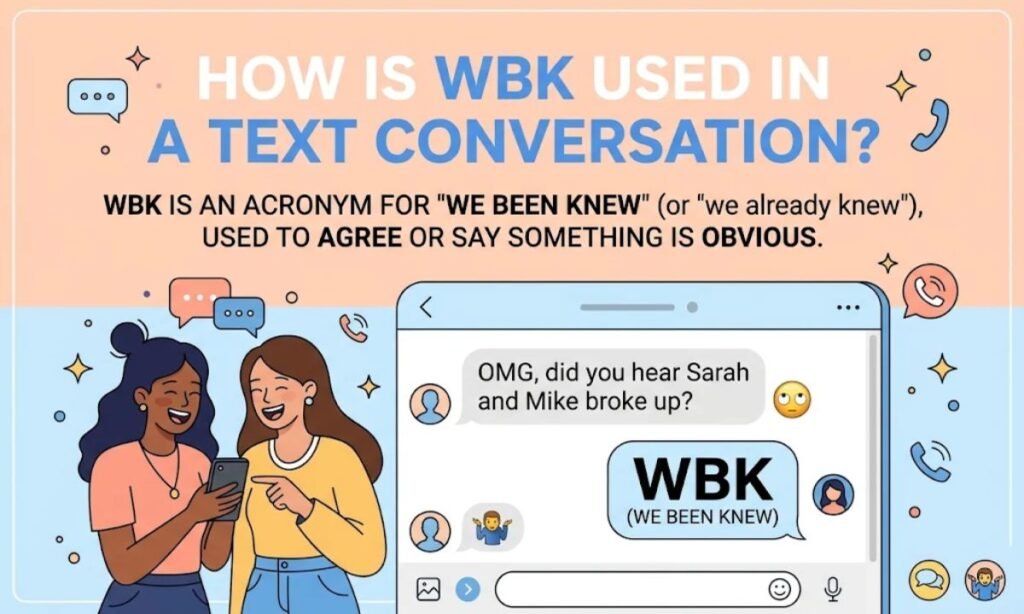
In text messages, WBK is a quick reaction. It usually follows a statement the other person thinks is obvious. It can stand alone, open a sentence, or lead into extra detail. Capital letters are common, but lowercase works fine.
Most people add a short follow-up to keep the tone friendly. “WBK, but thanks for confirming” feels warm. A bare “WBK.” can feel cooler. The follow-up does the work of softening or sharpening the message.
Below are a few WBK slang examples from everyday chats. Notice how each one changes with context. The same three letters can show excitement, humor, or a little eye roll.
- Crush rumor: “I think Mia likes Daniel.” Reply: “WBK. She talks about him daily.”
- Food opinion: “This place has the best fries.” Reply: “WBK! That’s why I ordered two portions.”
- School complaint: “Our teacher gives too much homework.” Reply: “WBK, and today’s assignment is even longer.”
- Group chat: “Pizza night again?” Reply: “WBK, it’s Friday.”
- Sports talk: “That rookie is really fast.” Reply: “WBK, watch his highlights.”
WBK Meaning in Text Urban Dictionary
People often check Urban Dictionary when a new abbreviation shows up. It’s a user-submitted site, so entries vary in quality and sometimes disagree. For WBK, you’ll generally see the “we been knew” meaning described in some form. Treat any entry as a hint, not a final answer.
That’s the catch with crowd-sourced slang pages. Anyone can write a definition, so humor, jokes, and guesses mix with real usage. A good habit is to compare a few entries and then check how people actually use the term in comments and chats. Real conversation beats a single definition.
If you’re ever unsure about a WBK definition, look at the message around it. The reply right before WBK tells you almost everything. An opinion, a rumor, or a “did you know” moment almost always signals “we been known.”
- Strength of Urban Dictionary: captures fresh slang quickly
- Weakness: entries aren’t verified and can be exaggerated
- Best use: quick check, then confirm with real examples
- Better test: read the message before WBK for context
- Tip: if definitions conflict, trust the one that fits the conversation
- Example: a “WBK” reply under a celebrity news post almost always means “we been knew”
What Does WBK Stand for in Basketball?

If you searched this, here’s the honest answer. WBK isn’t a standard basketball abbreviation. You won’t find it in common box score terms like PTS, REB, or AST. So if it appears in a sports chat, it’s almost certainly slang.
Sports fans use “we been knew” all the time, though. A player has a huge game, and someone types “WBK.” It means they saw the talent coming long ago. That’s likely why people connect WBK with basketball in the first place.
There’s one exception worth noting. Abbreviations can stand for a team, a league, a player’s initials, or a fan account. If the letters sit inside a name or a hashtag, it could mean something else entirely. Context decides.
- Official stat term? No
- Common sports use: “we been knew” after a player’s big performance
- Example: “He just dropped 40.” Reply: “WBK, he’s been elite all year.”
- Possible other uses: initials, team nicknames, usernames, fan pages
- How to check: look at the surrounding sentence or hashtag
- Rule of thumb: if it reacts to news or an opinion, it means “we been knew”
Common Tones Behind WBK
The meaning of WBK stays steady, but the feeling shifts. A smiling emoji, a period, or the topic can all change how it lands. That’s why context and tone matter more than the letters. Below are four tones you’ll see most.
Reading tone is a skill, and it comes from practice. Tone shows up in punctuation, timing, and who’s talking. A friend’s WBK at midnight feels different than a stranger’s WBK in an argument.
Let’s break each tone down with simple examples. You’ll start spotting them quickly. After a few chats, it becomes second nature.
- Four main tones: agreement, playful confidence, sarcasm, mild dismissal
- Tone clues: emojis, punctuation, relationship, topic
- Rule: the closer the friendship, the friendlier the WBK usually is
Agreement
Agreement is the friendliest use. You’re saying “yes, totally, and it’s been true forever.” It shows enthusiastic agreement without writing a full sentence. Fans use it a lot to bond over shared opinions.
It works well in fandom discussions and group chats. Everyone nods along, and the vibe stays warm. It feels like a quick high five.
- “Zendaya always looks amazing.” Reply: “WBK.”
- “This album is perfect.” Reply: “WBK, been on repeat since release.”
- Meaning: “Yes, everyone already knows that.”
- Best for: friends, fandom spaces, shared interests
Playful Confidence
Here, WBK sounds a bit dramatic and proud. It often shows up when someone compliments you. You answer with playful confidence, like you’ve heard it a hundred times.
This one needs a friendly relationship. With close friends it’s pure humor. With strangers it might read as bragging.
- “You’re definitely the best cook in the family.” Reply: “WBK, but thank you.”
- “You’re so good at editing videos.” Reply: “WBK 😂”
- Meaning: “I know, and I’m joking about it.”
- Best for: siblings, close friends, jokes
Sarcasm
Sarcasm turns WBK into a wink. You’re pointing out that something was painfully obvious. Mild sarcasm and humor and irony live here. It often targets shared annoyances.
The tone depends on the group. Among friends, it’s funny. In a stiff setting, it can feel snarky.
- “That meeting could’ve been an email.” Reply: “WBK.”
- “The Wi-Fi is down again.” Reply: “WBK, it’s Monday.”
- Meaning: “Of course that happened.”
- Best for: office jokes between friends, shared frustrations
Mild Dismissal
This is the tone to watch. WBK can make the other person’s news feel small. It suggests they’re late to the party. Mild dismissal is the version that can hurt feelings.
Without a friendly signal, the reply may sound cold. A period at the end and no emoji makes it worse. If you want to avoid this, add a short follow-up.
- “I just found out the store closes early on Sundays.” Reply: “WBK.”
- Possible feeling: “You should’ve known that already.”
- Fix: add warmth, like “WBK, but good reminder!”
- Avoid in: tense chats, emotional topics
Is WBK Rude?
WBK isn’t automatically rude. Its effect depends on the relationship, the topic, and the punctuation. With close friends, it usually feels playful. In arguments, it can sound condescending.
Small details change the mood. Compare “WBK 😂” with “WBK.” The emoji says “relax, I’m joking.” The period says “we’re done here.” That’s the same abbreviation with two very different reactions.
Be careful when someone shares something personal. A one-word WBK to a vulnerable message can feel dismissive. If a friend says, “I think my manager treats me unfairly,” a better reply is, “I noticed that too. Want to talk about it?”
- Usually friendly: among friends, in fandoms, in memes
- Can feel rude: in arguments, with strangers, in serious talks
- Softeners: emojis, “haha,” a follow-up sentence
- Sharpeners: a period, no emoji, replying to a vulnerable message
- Example (kind): “WBK 😂 love that for you.”
- Example (cold): “WBK.”
What Does WBK Mean on TikTok?

WBK meaning on TikTok matches the text meaning: “we been knew.” Users drop it in comments when a video confirms what they already believed. It often sits near the top of a comment thread, collecting likes from people who agree.
A creator might post a clip with the caption, “Proof she’s one of the best vocalists.” Fans comment “WBK,” meaning her talent was never in doubt. The abbreviation also shows up under glow-up videos, relationship stories, product reviews, and fashion content.
TikTok users like to stretch it with extra words. These small additions add humor and a sense of community. That’s a big reason WBK meaning on social media feels playful rather than flat.
- Typical comment: “WBK since day one.”
- With emojis: “WBK 😭”
- With a twist: “WBK and you finally noticed?”
- Common under: celebrity clips, glow-ups, product tests, relationship stories
- Also seen in: Instagram comments, Instagram messages, reaction memes
- Why it spreads: short, expressive, easy to copy
Does WBK Have Other Meanings?
“We been knew” is the main meaning in texting and social media platforms. Still, abbreviations can have different definitions in professional communication, technical fields, or local settings. WBK might stand for a company, a department, a location, or a username.
The surrounding words usually give it away. If someone writes, “Send the report to WBK,” they’re probably not saying “we been knew.” They likely mean an office, a team, or a client. That’s a context and tone call.
Here’s a simple rule. If WBK reacts to an opinion, a rumor, or a piece of news, it’s slang. If it sits where a name or label would go, it’s probably an acronym for something else.
- Slang meaning: we been knew (most common)
- Possible other meanings: initials, company or project names, locations, usernames
- Example (slang): “That actor is so funny.” Reply: “WBK.”
- Example (other): “Please email the file to WBK.”
- Clue: reaction to news means slang, label in a sentence means something else
- When unsure: ask, “WBK as in ‘we been knew’ or something else?”
WBK vs. “I Know”
WBK and “I know” are cousins, not twins. “I know” confirms awareness and stays neutral. WBK adds history and attitude. It says the knowledge has been around for a long time, and the speaker was there from the start.
Take the line “She’s really funny.” Reply “I know,” and you’ve agreed calmly. Reply “WBK. Her old videos were hilarious too,” and you’ve added backstory and swagger. That extra flavor is why people choose WBK.
The tradeoff is formality. “I know” works almost anywhere. WBK fits casual messages but looks out of place in formal writing. WBK vs I know really comes down to tone and setting.
- “I know”: neutral, polite, works in most settings
- WBK: confident, expressive, casual only
- Example 1: “She’s really talented.” Reply: “I know.”
- Example 2: “She’s really talented.” Reply: “WBK. Her first mixtape proved it.”
- Use “I know” when: talking with a boss, teacher, or someone new
- Use WBK when: chatting with friends, fandoms, online communities
WBK vs. IK, IKR, and FR
Several casual chat abbreviations sit close to WBK. Each one carries a slightly different feeling. Picking the right one keeps your message clear. Here’s a quick breakdown.
Think of them as four gears. IK is the calm gear. IKR is the exciting gear. FR is the sincere gear. WBK is the “I told you so” gear. The more you use them, the easier it gets.
Use the list below as a cheat sheet. It also helps with WBK vs IK, WBK vs IKR, and WBK vs FR. Related abbreviation WB means “welcome back,” which is different from WBK.
- IK: I know
- IKR: I know, right?
- FR: for real
- WB: welcome back
- WBK: we been knew
IK
IK means “I know.” It’s direct and neutral. It confirms you’re aware without adding drama. That makes it safe in most casual chats.
- “You need to charge your phone.” Reply: “IK.”
- Tone: calm, simple
- Best for: quick acknowledgment
IKR
IKR means “I know, right?” It invites a shared reaction. You’re agreeing and asking the other person to join in. It feels excited and social.
- “That ending was shocking.” Reply: “IKR!”
- Tone: enthusiastic, friendly
- Best for: reacting together to shocking or funny things
FR
FR means “for real.” It can show agreement, sincerity, or surprise. Because it’s flexible, it fits many moments. Tone depends on punctuation and context.
- “This week felt endless.” Reply: “FR.”
- Tone: honest, relatable
- Best for: sincere agreement or genuine surprise
WBK
WBK means the information has been known for a long time. It sounds the most confident of the group. It also carries the strongest “I was here first” energy. Use it when that flavor fits.
- “She deserves more recognition.” Reply: “WBK.”
- Tone: confident, a bit dramatic
- Best for: obvious facts, fandom talk, playful bragging
How to Reply When Someone Says WBK
Your best reply matches the mood. If the person agrees with you, keep the energy up. If they sound sarcastic, joke back. If they sound rude, stay calm and clear things up.
A good reply doesn’t need to be clever. A short, honest line works. The goal is to read whether they’re being friendly, playful, or dismissive. Then respond to that, not just the three letters.
Here are ready-made options for each situation. Pick one and tweak it to sound like you. Natural beats are polished every time.
- If they agree: “Exactly!” / “Right? It’s always been obvious.” / “Finally, someone said it.”
- If they’re playful: “Okay, I’m late to the party.” / “Let me catch up!”
- If it feels sarcastic: “Well, nobody told me 😅”
- If it feels rude: “I only said it because I just found out.”
- To clear the air: “I know you knew, but it was new to me.”
- Example chat: “I just learned Sunday is free parking.” Reply: “WBK.” You: “Lol, you could’ve told me sooner!”
When Should You Use WBK?
Use WBK in relaxed spaces where slang feels natural. It fits friends, siblings, classmates, and online communities. It’s also perfect for memes, group conversations, and fandom discussions where people share inside jokes.
It works best when the fact really is obvious. Maybe an update confirms what everyone expected. Maybe you’re joking about something predictable. In those moments, WBK feels sharp and funny.
Before you send it, take two seconds. Ask yourself if the other person will read it as playful. If the answer is yes, go ahead. That small check is basic texting etiquette.
- You strongly agree with something obvious
- A news update confirms what everyone guessed
- You’re joking about something predictable
- You want a playful, dramatic tone
- You’re joining a meme thread or fandom chat
- Example: “That character is secretly the villain.” Reply: “WBK! The clues were there from episode one.”
When Should You Avoid WBK?
Skip WBK in job applications, business emails, school assignments, customer complaints, legal messages, and other formal writing. It’s casual and can confuse readers. Formal writing needs standard English, plain and clear.
Also avoid it when someone shares painful news. A short slang reply can feel careless, even if you don’t mean it that way. If a friend says they’re struggling at work, “WBK” isn’t supportive. Try asking what happened instead.
Another time to hold back is when your reader may not know slang. Parents, older relatives, and new coworkers might misread it. Clear words beat clever shorthand in those cases.
- Avoid in: work emails, school papers, legal messages, formal letters
- Avoid when: someone shares bad news or personal worries
- Avoid with: people unfamiliar with slang
- Professional swap: “We were already aware of this.”
- Better emotional reply: “I noticed that too. Are you okay?”
- Rule: match the words to the weight of the moment
Examples of WBK in Everyday Messages
Seeing real examples makes the meaning stick. These show how WBK adds personality to a simple agreement. They also show how the same abbreviation fits many topics. Read them out loud, and you’ll hear the tone.
Notice how each reply either adds a detail or a joke. That’s the sweet spot. A bare WBK works, but a short follow-up makes it feel human and warm.
Use these as templates. Swap in your own names, shows, and inside jokes. That keeps your messages original.
- “Your little brother is so competitive.” Reply: “WBK. He turns everything into a contest.”
- “This café beats the one downtown.” Reply: “WBK, their coffee is fresher.”
- “I think that character is the villain.” Reply: “WBK! The clues were there from episode one.”
- “She should release a full album.” Reply: “WBK, fans have asked for years.”
- “Your dog acts like he owns the house.” Reply: “WBK. We just pay the bills.”
- “This phone has the best battery.” Reply: “WBK, that’s why I bought it.”
Also read meanings on IMAO Meaning in Text: What Does This Popular Slang Really Mean in 2026?
Tips for Using WBK Naturally
Don’t overuse it. Slang loses charm when every message has it. Save WBK for moments where it fits the story. One well-placed WBK beats five forced ones.
Match your crowd too. A fandom server will love it, while a family chat might need a translation. If you’re unsure, add a short explanation the first time. That keeps everyone included.
Finally, mix it with your own voice. Add a detail, a joke, or a reason. That’s how slang stays personal and not copied.
- Keep it rare: use it when it truly fits
- Know your audience: friends and fandoms over formal groups
- Add detail: “WBK, her first single was already great”
- Use emojis wisely: they soften tone
- Check your timing: skip it during serious talks
- Example: “WBK 😂 but I love that you finally watched it.”
Conclusion
WBK Meaning in Text is simple once you know it. WBK stands for “Welcome Back.” People use it to greet someone who has returned. It can be after a trip, a break, or a long gap. The tone is warm and friendly. It saves time in quick chats. You will see it in texts, comments, and gaming chats. Now you know what it really means.
Using WBK Meaning in Text the right way makes your chats feel kind and personal. Use it with friends, family, and online buddies. Add an emoji to make it feel extra warm. Keep it casual and skip it in formal emails. A small “WBK” can make someone feel missed. Slang keeps changing, but this one stays friendly. Try it today and welcome someone back.
FAQs
What does “WBK” mean?
WBK stands for “Will be back” or “Wanna be known,” depending on the chat context. Most often it simply means someone is stepping away and will return soon.
What is WBK short for?
WBK is short for “will be back.” It’s a quick way to tell someone you’re leaving the chat for a moment.
How to use WBK in a sentence?
“Gotta grab my food, WBK in 10 minutes!” It works best at the end of a message when you’re pausing a conversation.
What does WDYK mean in chat?
WDYK means “What do you know?” It’s used to ask what someone knows or has heard about a topic.
1 thought on “WBK Meaning in Text: Discover What This Trending Slang Really Means in 2026”